Does the Next Rig Earn Its Slot? Testing the Increment
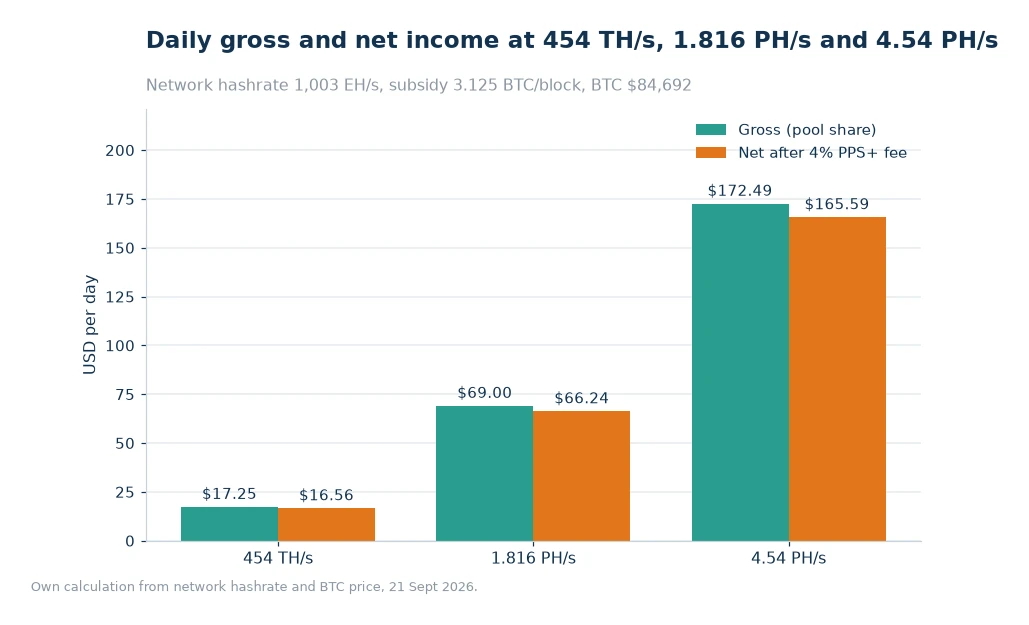
The average return of a farm says nothing about the rig you are about to bolt onto it. At 454 TH/s a new machine adds 0.00020367 BTC a day, or $17.25 gross and $16.56 after the listed 4% on the block-reward component. The combined farm at 4.54 PH/s reaches $172.49 and $165.59. The purchase turns on the difference between those lines, not on the total.

Key takeaways
- A 454 TH/s addition is worth $17.25 gross and $16.56 net a day at current BTC conditions.
- The existing 4.086 PH/s farm keeps earning $155.24 gross whether or not the new rig arrives.
- Marginal power, marginal cooling and marginal space decide the purchase; average figures do not.
- If the new rig pushes the circuit past its rating, the arithmetic is irrelevant until the service is upgraded.
The question is marginal, not average
Farms are usually described by totals: total hashrate, total revenue, total cost. Purchases are not decided by totals. A purchase is decided by what changes when one more machine joins, and that is a different calculation with different inputs. The existing machines are sunk. Their output is the baseline, not the prize.
This distinction matters most when the farm is already covering its fixed costs. Once the building, the transformer and the network drop are paid for, every additional rig carries only its own power, its own share of cooling, and its own purchase price. That is a much easier bar to clear than the average bar, and it is the bar the seller should be asked to meet.
Fixed costs that do not move
Rent, the internet line, the monitoring subscription and the electrician's retainer do not change when one machine arrives. Those belong to the baseline. What moves is the power draw, the heat load and the rack space, plus whatever marginal firmware or network configuration the new unit needs. Any cost that stays the same is not part of the decision.
Splitting the sheet this way also prevents a common accounting error: allocating the whole monthly rent to the new rig and concluding it is unprofitable. The rent was being paid before the rig existed. Allocating it again is double counting, and it kills purchases that would have been fine.
Increment versus whole farm at 454 TH/s
The table isolates the addition. The existing farm is 4.086 PH/s, and the new rig brings the total to 4.54 PH/s.
| Scope | Hashrate | Gross per day | Net per day | Share of output |
|---|---|---|---|---|
| Farm as it stands | 4.086 PH/s | $155.24 | $149.03 | 90% |
| Rig under consideration | 454 TH/s | $17.25 | $16.56 | 10% |
| Farm after installation | 4.54 PH/s | $172.49 | $165.59 | 100% |
Ten percent is the number that matters here. One rig in a ten-rig farm adds a tenth of the output and a tenth of the heat, which is usually a manageable step. The same rig in a two-rig farm would add a third, and the cooling and circuit headroom would need a much harder look before the purchase made sense.
When a second rig dilutes the first
Adding hashrate never dilutes your own share of the pool, because the pool share is set by your hashrate against the pool total, not against your other machines. What it can dilute is the quality of service: shared cooling that was comfortable at eight machines becomes marginal at ten, and a single circuit breaker that never tripped starts tripping.
Those are engineering limits wearing financial clothes. A farm that runs hot will see hashrate throttle, and a throttled machine produces less than the calculator promised. Before buying, walk the aisle with a thermal camera or a cheap probe and find the hottest point. If the new rig would sit downstream of that point, budget for airflow before budgeting for the machine.
Power headroom as the real constraint
Every circuit has a rating, and the useful question is not how much power the farm uses but how much it can add without a service upgrade. A service upgrade is a capital project with a lead time measured in months, which turns a simple purchase into a construction decision. Most operators discover this at the quoting stage, which is the right time to discover it.
Write the headroom in kilowatts on the same sheet as the revenue projection. If the new rig consumes the last of it, the next purchase will need the upgrade, and the true cost of this rig includes the option value of that headroom. That is an opportunity cost, not a line item, but it belongs in the decision anyway.
A go/no-go line for the purchase
One line decides it: the incremental net revenue minus the incremental power and cooling cost minus a monthly share of the purchase price over its expected service life. If that comes out positive at today's difficulty and still positive at difficulty five percent higher, the rig clears. If it only clears at today's difficulty, the purchase is a wager on the network slowing down.
Use the same test for a used machine, with a shorter service life and a repair allowance. Used hardware often clears the first line and fails the second, because the remaining life is short enough that a single board failure erases the margin. That is not a reason to avoid used equipment; it is a reason to price the risk explicitly rather than hope it away.
To keep the numbers current, rebuild the incremental line in the ViaBTC Mining Calculator whenever the difficulty estimate moves by more than a couple of percent. The Profit Calculator will not know your circuit rating or your cooling margin, so those two inputs stay on your own sheet next to the output.
Worked example
Take the rig on its own, then attach it to the farm.
- Gigahash: 454 TH/s = 454,000 GH/s.
- Network share: 454,000 ÷ 1,003,107,267,295 = 0.00000045259.
- Daily coins: 0.00000045259 × 450 = 0.00020367 BTC.
- Gross: 0.00020367 × 84,692 = $17.25.
- Listed 4% line: 17.25 × 0.04 = $0.69.
- Net from the rig: 17.25 − 0.69 = $16.56 a day.
- Farm total: 172.49 gross, 165.59 net, so the rig contributes 17.25 ÷ 172.49 = 10.0% of gross output.
- Annualised, before power: 16.56 × 365 = $6,044.40 from the single machine.
Now subtract the marginal costs. If the rig draws its share of a $0.06 tariff and the cooling adds a quarter of that again, the power line may take a large bite of the $16.56. The remainder, divided into the purchase price, is the payback in months. Compare that with the service life and with the difficulty trend before signing anything.
Frequently asked questions
Should I judge a new rig on farm averages?
No. The existing machines earn the same whether or not the new one arrives, so the purchase should be judged on its own added revenue against its own added cost, with shared fixed costs left in the baseline.
How much does one 454 TH/s rig add to the farm?
At 4.54 PH/s total it adds 10% of gross output, which is $17.25 a day before the listed rate and $16.56 after it at BTC $84,692.
What if the circuit cannot take another machine?
Then the purchase is really a service-upgrade project, and the cost and lead time of that upgrade belong in the decision; a rig that cannot be powered safely has no incremental revenue at all.
Add the rig only after the line clears
Run the incremental line once with today's inputs, once with difficulty five percent higher, and once with the rig's measured hashrate after a week rather than the brochure figure. If all three clear, install it. If two clear, wait a month and look again, because the Miner Profitability Ranking will show whether the model is falling behind the network or holding its place. The Mining Farms listings are useful if the answer is a hosted slot rather than another machine on your own concrete.
Sources: calculator, miner ranking and farms pages at viabtc.com. The 21 Sept 2026 read gave 1,003 EH/s, a 3.125 BTC block reward, 144 blocks a day and BTC at $84,692[1]. Increment figures assume continuous operation. Published 24 Oct 2026.